
Diffusing Anxiety by Living in the Moment
for backtothepresent.net
The Role of the Creative Abilities in Guiding Our Choices
At the core of our Creative Abilities is our Decision-Making itself—the unique human power to freely choose what we will do, feel, or think next. Each layer of the Creative Abilities influences how we make those choices. Our Satisfactions motivate us through the pull of Needs, Wants, and Desires; our States of Emotional Being reflect what we hope the decision will produce; our Elements of Our Psyche—the id, ego, and superego—shape how we interpret and pursue outcomes; and our Levels of Consciousness determine the depth of awareness we bring into each moment.
However, most of us were taught to rely almost exclusively on our Intellect, using the ego to pursue what we want, believing this would make us happy. We never learned to use the intuitive tools of loving intention—the tools found in the Toolbox for a Joyful Life—to fulfill what we desire, the deeper spiritual aim that brings joyfulness. True Decision-Making requires the guidance of Intuition through the superego, allowing decisions to be grounded in empathy, communication, sacrifice, and faith. Once we teach these intuitive tools clearly, accessing the Toolbox becomes simple, and children and adults alike learn how to create the joyful emotional outcomes they actually desire.
IMPULSE
(UNCONSCIOUS MIND – PHYSICAL NEEDS – INSTINCT – CONTENTMENT)
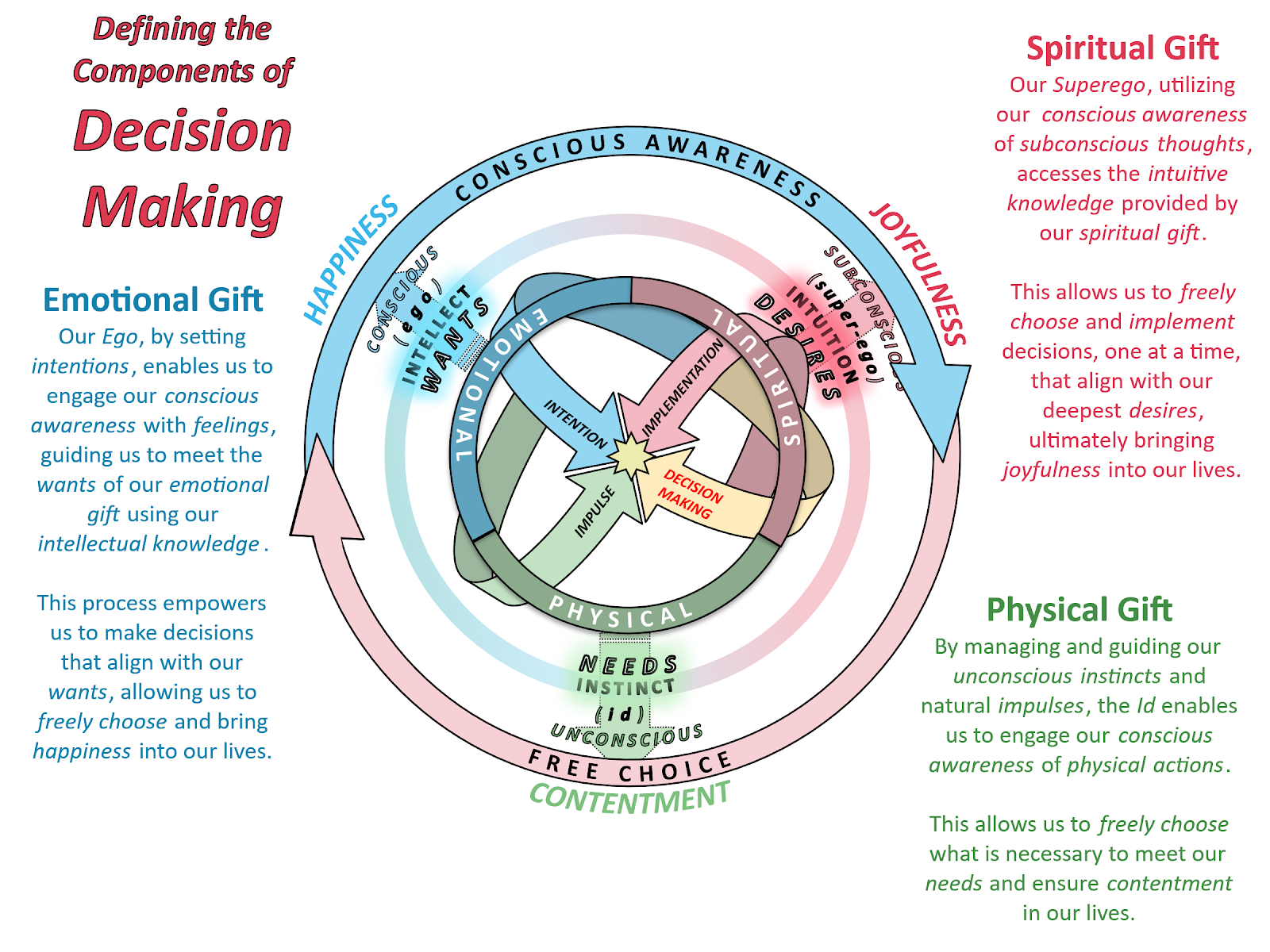
Impulse represents the first stage of Decision-Making, emerging from the Unconscious Mind and directed by the id, using the Source of Knowledge of Instinct. This stage focuses on fulfilling immediate Needs such as hunger, safety, and rest.
When these needs are satisfied, they create temporary contentment, a foundational but fleeting State of Emotional Being.
Example
You’re working late and suddenly feel hungry.
On Impulse, you grab chips because it's fast.
Your hunger fades, giving you temporary contentment, but it doesn’t serve long-term well-being.
Key Insight:
Impulse-based decisions are fast and sometimes necessary, but they rarely honor long-term values or emotional and spiritual outcomes.
INTENTION
(CONSCIOUS MIND – EMOTIONAL WANTS – INTELLECT – HAPPINESS)
The second stage, Intention, engages the Conscious Mind and the ego, guided by the Source of Knowledge of Intellect. Here, decisions become deliberate and goal-oriented, focused on fulfilling Wants and producing short-term happiness.
The ego works as a bridge between primitive needs and higher aspirations, helping choices feel purposeful and aligned with personal goals.
Example
You pause and consider a healthier option.
Instead of chips, you prepare a small balanced meal.
You meet your want for food and support your health goals, creating short-term happiness.
Key Insight:
Intention-based decisions are thoughtful but often still temporary, aimed at emotional satisfaction rather than deeper spiritual desires.
IMPLEMENTATION
(SUBCONSCIOUS MIND – SPIRITUAL DESIRES – INTUITION – JOYFULNESS)
The highest stage, Implementation, engages the Subconscious Mind and the superego, drawing upon Intuition, the deepest Source of Knowledge. Decisions at this level align with Desires, moral values, and spiritual purpose. These choices generate lasting joyfulness, the most profound State of Emotional Being.
The superego ensures decisions reflect loving intention, relational responsibility, and alignment with higher values.
Example
You take the reflection further:
Instead of eating alone, you invite your family to prepare a healthy meal together.
Your hunger is satisfied, your relationships deepen, and shared time creates lasting joyfulness.
Key Insight:
Implementation-based decisions consider long-term impact, nurture relationships, and align with spiritual Desires, creating enduring fulfillment.
COMPARISON OF THE THREE STAGES OF DECISION-MAKING
Stages of Decision-Making
Impulse
Intention
Implementation
Satisfaction
Immediate Physical Needs
Short-term Emotional Wants
Long-term Spiritual Desires
Source of Knowledge & Element of Psyche
Instinct – id
Intellect – ego
Intuition – superego
Outcome
State of Emotional Being
Temporary contentment
Short-term happiness
Lasting joyfulness
This progression reveals how Conscious Awareness elevates Decision-Making from reactive choices to intentional and intuitive actions, aligning decisions with the Three Gifts and deeper Creative Abilities.
KEY THEMES
The diagram highlights how our Three Gifts, Manifestations, Sources of Knowledge, and Creative Abilities work together every time we make a decision.
Each stage builds on the previous one, moving from Impulse (Unconscious) → Intention (Conscious) → Implementation (Subconscious).
As awareness increases, decisions increasingly align with our Unique Abilities, enriching our experiences of contentment, happiness, and joyfulness.
IMPLICATIONS FOR MINDFULNESS
Mindfulness strengthens Decision-Making by grounding you in the moment and reconnecting your Actions, Feelings, and Thoughts to your Physical, Emotional, and Spiritual Gifts.
When making decisions mindfully, you:
Recognize when you are acting on Impulse.
Pause and set Intention with loving awareness.
Shift into Implementation, guided by Intuition and relational responsibility.
While contentment and happiness are meaningful, joyfulness arises when choices reflect your Spiritual Gift, loving intention, and commitment to healthy relationships.
Ultimately, Decision-Making becomes a pathway toward higher consciousness—integrating id, ego, superego with the Creative Abilities and the Critical Understandings, showing how mindful, loving choices create a life rooted in presence, meaning, and joy.